What Is VAE Powder and What Is It Used For?
When builders open a bag of VAE Powder, they find a fine, free-flowing material rather than a liquid resin. VAE Powder usually means a redispersible vinyl acetate-ethylene copolymer powder. It is added to cement-based and gypsum-based mixtures to improve bonding, flexibility, and workability. After mixing with water, the particles disperse and form a polymer film as the material dries. That film can help mortar adhere to concrete, ceramic tiles, insulation boards, and other surfaces.
Not magic.
In practical construction, VAE Powder appears in tile adhesives, skim coats, repair mortars, self-leveling compounds, and exterior insulation systems. A tile installer may notice smoother spreading and stronger adhesion along a wall edge. A plasterer may value reduced cracking during drying. In a self-leveling compound, the powder can support better cohesion and surface durability. These benefits depend on the complete formulation, not the polymer alone. Cement type, water ratio, fillers, curing conditions, and dosage all matter.
Too little may provide limited improvement. Too much can affect cost, drying, or surface behavior. This detail is often overlooked. Reliable product selection requires checking the technical data sheet, recommended dosage, particle characteristics, and storage conditions. A small test panel can reveal problems before full-scale application. Experienced formulators also compare adhesion, flexibility, water resistance, and workability after curing. The following guide explains what VAE Powder is, how it functions, and where its practical value becomes most visible.
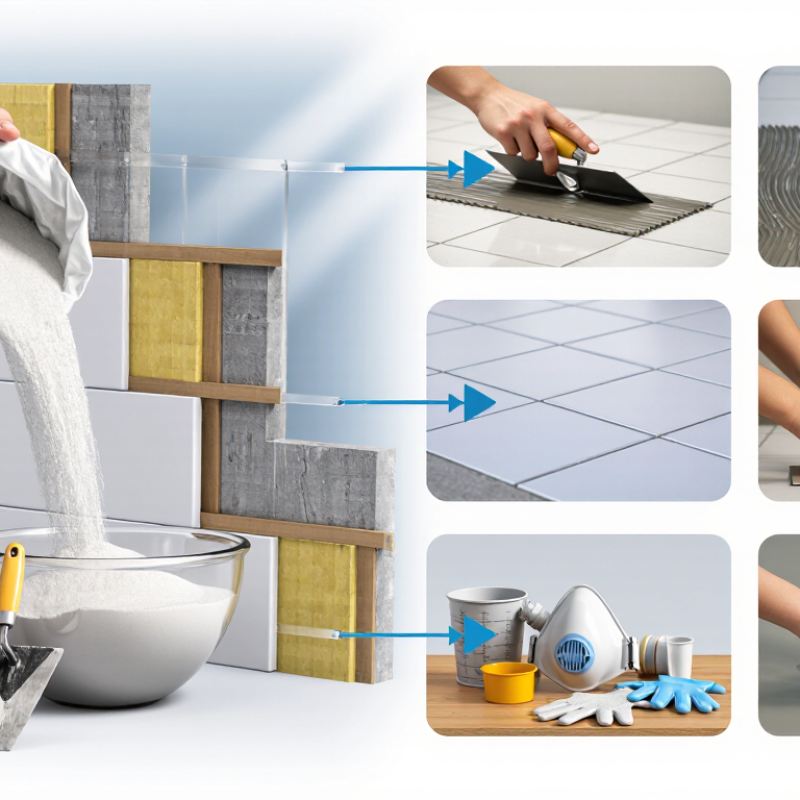
What Is VAE Powder?
VAE powder is a spray-dried vinyl acetate–ethylene copolymer. It looks like a fine, pale powder and redisperses when mixed with water. Protective colloids help keep its particles stable during storage and mixing. In a cement-based mortar, the polymer forms a flexible film as water evaporates. This film can improve adhesion, flexibility, workability, and resistance to small cracks.
It is widely used in tile adhesives, skim coats, self-leveling compounds, repair mortars, and external insulation systems. A 2024 construction chemicals report from Grand View Research estimated the global market at about USD 82.6 billion in 2023. That figure does not measure VAE powder alone, but it shows the scale of its application environment. Global construction output is also projected to expand strongly through 2037, according to Oxford Economics and Global Construction Perspectives. Performance still depends on dosage, cement type, curing conditions, and formulation design. More powder is not always better. Laboratory testing should check adhesion, open time, flexibility, and water resistance under real conditions. I have found one limitation worth noting: VAE powder may improve handling, but it cannot repair poor aggregate grading or careless mixing.
What Is VAE Powder and What Is It Used For?
VAE powder is a redispersible vinyl acetate–ethylene copolymer powder used in cement- and gypsum-based dry-mix products. It improves adhesion, flexibility, cohesion, crack resistance, and water resistance after mixing with water.
How to read the chart: VAE powder is commonly used at approximately 1–6% of the dry formulation, depending on the application. Higher levels are often selected when stronger adhesion, greater flexibility, or improved crack resistance is required. Actual dosage depends on the cement system, fillers, additives, substrate, and performance requirements.
How Is VAE Powder Manufactured?
VAE powder is a spray-dried vinyl acetate-ethylene copolymer used in dry-mix construction materials. Its performance depends heavily on how it is manufactured. The process begins with emulsion polymerization, where vinyl acetate and ethylene react in water. Protective colloids and stabilizers help control particle formation. Temperature, pressure, and stirring speed require close monitoring.
The resulting polymer dispersion is then concentrated and prepared for spray drying. In this stage, hot air removes water while atomized droplets form fine, free-flowing particles. A protective surface treatment may be added to improve storage stability and redispersion. The finished powder should disperse quickly when mixed with water. It should also create a flexible film after drying.
Quality testing normally checks moisture, particle size, bulk density, ash content, and redispersibility. Adhesion and flexibility tests are also important for practical applications. Experienced formulators compare laboratory results with mortar performance, because numbers alone can mislead. A powder may show good redispersion but still perform poorly in a demanding tile adhesive. This is easy to underestimate.
Manufacturing is not perfectly uniform. Raw material variation, drying conditions, and storage humidity can change the final behavior. Careful sampling helps identify these differences before shipment. Yet even controlled production has limits. Application design, mixing water, and curing conditions still influence the result.
What Are the Key Properties of VAE Powder?
VAE powder is a redispersible vinyl acetate-ethylene copolymer used in dry-mix construction materials. Its most important property is water redispersibility. When mixed with water, the powder forms a polymer dispersion again. This allows it to create a continuous film as the material dries. The film can improve adhesion between mortar and surfaces such as concrete, ceramic, or gypsum board.
VAE powder also provides flexibility and crack resistance. A thin polymer film helps absorb small movements caused by temperature changes or substrate shrinkage. It can improve workability, making mortar smoother and easier to spread with a trowel. Some grades also increase abrasion resistance and reduce water penetration. However, the powder does not make every mixture waterproof. Performance depends on dosage, curing conditions, and the surrounding formula.
In field applications, storage deserves attention. Moisture can cause clumping before mixing, so sealed packaging and dry warehouses matter. During production, the powder should disperse evenly to avoid weak spots or uneven bonding. I have found that excessive dosage may improve flexibility but reduce hardness or increase cost. This trade-off is easy to overlook. Testing should examine adhesion, open time, water resistance, and flexibility under realistic conditions. Results can vary between cement-based and gypsum-based systems.
What Is VAE Powder Used For?
VAE powder is a redispersible polymer powder made from vinyl acetate and ethylene copolymers. It becomes a flexible polymer film after mixing with water. This makes it useful in cement-based and gypsum-based dry mixtures. MarketsandMarkets estimated the global redispersible polymer powder market above USD 1.5 billion in 2023. Its forecast also indicates growth beyond USD 2 billion before 2029.
Its main use is improving construction mortar performance. Tile adhesives use VAE powder for stronger adhesion and better slip resistance. Self-leveling compounds use it to improve flow and reduce surface cracking. In exterior insulation systems, skim coats, and repair mortars, it supports flexibility and water resistance. Typical formulations may use roughly 1% to 5% powder, although the correct level depends on cement type, fillers, and performance targets. Testing should follow relevant standards, such as EN 12004 for ceramic tile adhesives.
VAE powder also improves dry-mix handling. Workers can measure one consistent powder instead of transporting liquid polymer. That matters on sites with limited storage space. The UNEP 2023 Global Status Report noted that buildings and construction produced 37% of global energy and process-related emissions in 2022. Better mortar durability may reduce repairs, but VAE is not a cure-all. Excessive dosage can increase cost, stickiness, or drying time. Poor mixing can still cause weak spots. Small laboratory trials remain necessary before production.
How Should VAE Powder Be Stored and Handled?
VAE powder is a redispersible vinyl acetate-ethylene polymer used in tile adhesives, repair mortars, and self-leveling compounds. Storage conditions strongly affect its performance. Keep unopened bags in a cool, dry, and well-ventilated room. Many technical data sheets recommend temperatures below 30°C and relative humidity below 65%, but the product-specific SDS should control.
Moisture is the main practical threat. Damp powder can form hard lumps and disperse poorly during mixing. Store bags on pallets, away from walls, floors, sunlight, and leaking pipes. Keep packaging sealed until use. Apply a first-in, first-out system. It sounds basic. It is often missed. Avoid stacking beyond the supplier’s stated limit, because pressure can damage bags and create unstable loads.
Handle the powder gently. Use local exhaust ventilation when opening bags or charging mixers. Safety glasses, gloves, and a suitable dust mask may be necessary after reviewing the SDS. Never use compressed air to clean settled powder.
OSHA recorded 281 combustible-dust explosions, 119 deaths, and 718 injuries in the United States between 1980 and 2005, showing why dust control deserves attention. NFPA 652 also calls for a dust-hazard analysis where combustible particulate solids may create fire or explosion risks. VAE grades differ, especially in additives and dust behavior. Assuming every powder behaves identically is a preventable mistake.