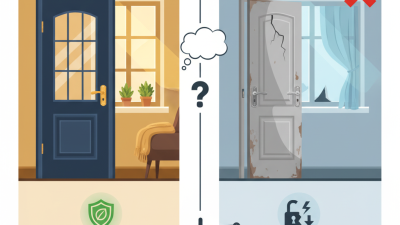
In 2026, global buyers are seeking door solutions that balance security, design, energy performance, and long-term value. A hotel entrance may need reinforced glass, quiet hinges, and heavy daily-use durability. A residential project may prioritize thermal insulation, smart access, and low maintenance. These needs cannot be solved by one universal door.
Experienced purchasing teams now assess the complete product system. They review the door leaf, frame, seals, hardware, locking method, finish, and installation process. They also request test reports, material data, warranty terms, and clear supplier records. In coastal regions, corrosion-resistant finishes can matter more than appearance. In colder climates, accurate sealing can reduce heat loss around the frame.
Smart doors are gaining attention, but technology should support people, not complicate everyday access. Biometric readers, mobile credentials, and remote monitoring require reliable power, data protection, and practical backup options. Simple matters.
This guide examines the top door solutions for global buyers, including commercial, residential, industrial, and hospitality applications. It considers steel, aluminum, timber, glass, fire-rated, acoustic, energy-efficient, and automated systems. Regional standards and project conditions must always be checked with qualified professionals. Supplier claims may sound impressive, yet independent verification remains essential. Even experienced buyers can overlook installation quality, replacement parts, or local service capacity. That is an imperfect reality. Still, careful comparison can reveal which door solutions deliver dependable performance, clearer costs, and stronger value throughout 2026.

Global door buyers are looking beyond appearance. The IEA’s 30% building-energy benchmark makes energy performance a central purchasing criterion. A suitable door should reduce heat transfer, control air leakage, and support stable indoor temperatures. Insulated cores, low-emissivity glazing, and thermally broken frames can improve performance in different climates.
Real project experience shows that installation matters as much as the product. A high-performing door can lose efficiency through uneven seals or an unsuitable threshold. Buyers should request tested U-values, air-tightness data, durability records, and clear maintenance guidance. Regional weather also matters. A coastal project may need stronger corrosion resistance, while a cold site requires careful attention to frame joints.
Tips: Compare whole-life performance, not only the purchase price. Ask for independent test reports and installation details. Check whether local technicians can replace seals and hardware. Small gaps become expensive over time.
Digital access systems may also improve security and operational control, but they should not replace reliable mechanical design. Some buyers focus too heavily on smart features. That can be a mistake. Simpler doors may perform better when maintenance resources are limited. Product claims should be verified under recognized testing methods, and energy targets should be reviewed after installation. A practical weakness remains: climate data, building use, and occupant behavior can change results. Good decisions need measurement, not assumptions.

Energy-efficient doors are now a serious buying criterion for global construction projects. The International Energy Agency’s Buildings 2023 report states that buildings consume about 30% of global final energy. A poorly sealed entrance can increase heating demand, especially in windy coastal areas or cold urban zones.
U-value measures heat transfer through the complete door assembly. Lower values indicate better insulation. However, a low U-value alone can mislead. Frame joints, thresholds, and installation gaps often create thermal bridges. Passive House Institute criteria commonly require building airtightness below 0.6 air changes per hour at 50 Pa. Door selection should therefore include tested air-leakage results, not only laboratory insulation figures. In Europe, EN 12207 air-permeability classification can help buyers compare performance. Test conditions still differ, which deserves attention.
Tips: Request the full test report. Check U-value units, climate assumptions, and installation details. Inspect the threshold seal with a smoke pencil during commissioning. Ask whether performance applies to the entire door set, rather than the leaf alone. The IEA also emphasizes stronger building envelopes as a practical route to lower energy demand. Yet buyers sometimes over-specify insulation and under-check hardware adjustment. That is an expensive mistake. A carefully installed mid-range door may outperform a superior product fitted poorly. Recheck seals after the first heating or cooling season.
| Door Solution | Typical Whole-Door UD Range W/(m²·K) |
Recommended Air-Leakage Performance | Best Thermal Features | Passive-House Compatibility | Best-Fit Climate or Application | Key Buyer Checks |
|---|---|---|---|---|---|---|
| High-Performance Insulated Opaque Exterior Door | 0.40–0.80 | Target EN 12207 Class 4; verify tested air permeability at 100 Pa. | Thick insulated core, low-conductivity frame, continuous perimeter gaskets, insulated threshold. | Strong candidate. A whole-door UD of ≤0.80 W/(m²·K) is commonly used as a Passive House door benchmark, subject to project certification requirements. | Cold, mixed, and heating-dominated climates; apartment and single-family entrances. | Request a complete-door test report, threshold detail, gasket durability data, and installation instructions. |
| Thermally Broken Glazed Entrance Door | 0.80–1.40 | Target EN 12207 Class 3–4, depending on size and configuration. | Thermal break in the frame, insulated glazing spacer, double or triple glazing, multi-point compression seal. | Possible with triple glazing, an insulated threshold, and a verified UD near or below 0.80 W/(m²·K). | Mixed and cold climates where daylight and visibility are important. | Check Ug, frame U-value, edge spacer, solar-control options, condensation resistance, and door-size limitations. |
| Triple-Glazed Passive-Performance Door | 0.60–0.90 | Target EN 12207 Class 4 with carefully sealed frame-to-wall installation. | Low-emissivity coatings, argon-filled cavities, warm-edge spacers, insulated frame, adjustable compression hardware. | Very strong candidate for Passive House projects when the installed product is accepted in the project’s energy model. | Cold climates, high-performance buildings, and low-energy public entrances. | Confirm whole-door UD, not only center-of-glazing Ug; review solar gain, safety glass, weight, and hardware capacity. |
| Thermally Broken Lift-and-Slide Door | 0.80–1.50 | Target the highest tested class available; sliding seals generally require more careful detailing than hinged doors. | Thermally separated frame, insulated sill, multi-chamber profiles, high-performance double or triple glazing. | Can be suitable, but large sizes and sill details must be verified in the project energy model. | Mild and mixed climates; balconies, patios, terraces, and accessible openings. | Check tested size, sill drainage, wind exposure, wheel durability, accessibility, and air leakage after installation. |
| Insulated Wood or Wood-Composite Door | 0.70–1.30 | Target EN 12207 Class 3–4 with stable seals and a properly sealed frame. | Low-conductivity timber, insulated core, moisture-resistant coatings, compression seals, insulated sill. | Potentially suitable when the complete assembly meets the required UD and airtightness levels. | Cold and mixed climates; projects prioritizing renewable or biobased materials. | Confirm moisture movement, coating maintenance, dimensional stability, fire rating, and regional certification. |
| Insulated Industrial Sectional Door | 0.50–1.20 | Use the manufacturer’s tested leakage result; continuous perimeter and panel-to-panel seals are essential. | Sandwich panels, thermal breaks, bottom seal, side and top seals, reduced panel joints. | Suitable for high-performance industrial buildings only when opening frequency and air leakage are included in the energy calculation. | Warehouses, workshops, logistics buildings, and loading areas in cold or mixed climates. | Review cycle life, wind-load rating, motor standby energy, safety sensors, maintenance access, and dock interface. |
| Rapid-Roll or High-Speed Interior Door | Not normally rated as a primary insulated exterior door | Prioritize low leakage at operating position and fast opening and closing cycles. | Flexible insulated curtain, side guides, tight bottom edge, automatic closing controls. | Useful as an internal air-separation layer, but it does not replace a certified airtight exterior envelope door. | Industrial facilities, cold-chain areas, clean zones, and high-traffic service openings. | Evaluate opening speed, traffic volume, pressure differential, safety, controls, and resistance to washdown or impact. |
| Cold-Storage or Refrigerated-Room Door | Approximately 0.30–0.80 | Specify low leakage together with vapor-tight perimeter seals and an insulated threshold where applicable. | High-density insulated core, vapor barrier, heated or thermally controlled frame where required, replaceable gaskets. | Not usually evaluated as a standard residential Passive House entrance door; performance depends on the refrigeration system and building model. | Freezers, chilled rooms, food processing, pharmaceuticals, and temperature-controlled logistics. | Verify temperature range, condensation control, vapor resistance, defrost strategy, emergency release, and maintenance requirements. |
For global buyers in 2026, fire and security doors must be selected as tested assemblies, not attractive standalone products. EN 1634-1 evaluates doorsets for fire resistance, including integrity and insulation. UL 10C focuses on positive-pressure fire testing. ASTM testing depends on the project’s risk and specification. ASTM E152 and ASTM E2074 are commonly referenced for fire door assembly performance.
A compliant leaf can still fail with the wrong frame, glazing, hinges, closer, or seal. That gap matters. In project reviews, I often see buyers compare certificates without checking installation conditions. This is risky. A test report should match the complete configuration, dimensions, hardware, wall type, and exposure direction. Security performance also needs a defined threat level, such as forced entry, impact, or ballistic resistance. ASTM does not provide one universal security rating for every door.
Tips: Ask for complete test reports, not brochures. Confirm the edition of each standard and its acceptance in the destination country. Check whether local authorities require third-party certification or site inspection. Keep spare seals and approved hardware available. Small substitutions can change performance. I have learned that “equivalent” components are not always equivalent in a tested assembly. A careful supplier should explain limitations clearly, including untested sizes, installation details, and maintenance requirements. Temperature, smoke leakage, and daily abuse deserve attention too. Fire performance is only useful when the door closes correctly every time.
EN 1634-1, UL 10C, and ASTM fire-test methods evaluate door assemblies under controlled fire exposure. The chart shows commonly referenced specification durations in minutes; the applicable rating depends on the complete tested assembly, jurisdiction, and certification requirements.
EN 1634-1 is a European fire-resistance test method for door and shutter assemblies. UL 10C is a positive-pressure fire test for door assemblies. ASTM E2074 is a fire-test method for door assemblies, commonly used with the ASTM E119 time-temperature exposure curve. A test method itself does not guarantee a specific rating for every product.
Accessible smart doors should be a core buying consideration for global projects in 2026. The World Health Organization estimates that 1.3 billion people experience significant disability worldwide. That figure includes wheelchair users, people with limited vision, older adults, and individuals with temporary injuries.
A practical door solution combines automation with human control. It may include low-force opening, wide clear access, tactile buttons, visual signals, and spoken feedback. Sensors should detect slow-moving users, not only fast traffic. A manual override remains essential when power or connectivity fails. In real buildings, small details matter. A heavy door, poor lighting, or an unclear threshold can defeat an expensive smart system. No system is perfect. Buyers should review accessibility testing, installation quality, maintenance plans, and local building requirements before purchasing. Data protection also matters when doors record movement or connect to access platforms.
Tips: Watch someone use the door while carrying a bag. Test it during a power outage. Check whether controls work from a wheelchair. Ask for repair response times and replacement-part availability. Avoid relying on app access alone. A useful design serves independence without making users request assistance. There is still room to improve, especially in older buildings where entrances were never designed for diverse bodies.
Global buyers in 2026 will compare more than appearance, price, and fire ratings. Sustainable door materials now need traceable evidence. An Environmental Product Declaration (EPD) reports measured environmental impacts across a product’s life cycle. It may cover raw materials, manufacturing, transport, installation, use, and disposal. That detail matters when doors cross borders. Climate results can change with electricity grids and shipping distances.
Procurement teams should check whether an EPD follows EN 15804 and relevant product category rules. They should confirm the program operator, declared unit, reference service life, and system boundary. A door listed per square metre is not directly comparable with one listed per unit. This mismatch can distort tenders. Ask for verification status and the publication date. Old declarations may not represent current steel, coatings, adhesives, or recycled content.
Circular procurement needs more than a recycled-content percentage. Buyers can track repairability, replaceable hardware, take-back routes, disassembly time, and material recovery rates. A door with 30% recycled steel may perform poorly if glued layers cannot separate. Test claims with a site sample. Open the frame. Count fasteners. Check whether damaged seals can be replaced without discarding the panel. These checks require experience, not only spreadsheets. Project reviews often reveal an uncomfortable gap: impressive carbon data can hide poor maintenance access. EPDs support better decisions, but they do not remove judgment. Keep assumptions visible.